Counterbalanced, Reach, and Warehouse Trucks – Pros and Cons of the Three Core Models
September 21, 2026
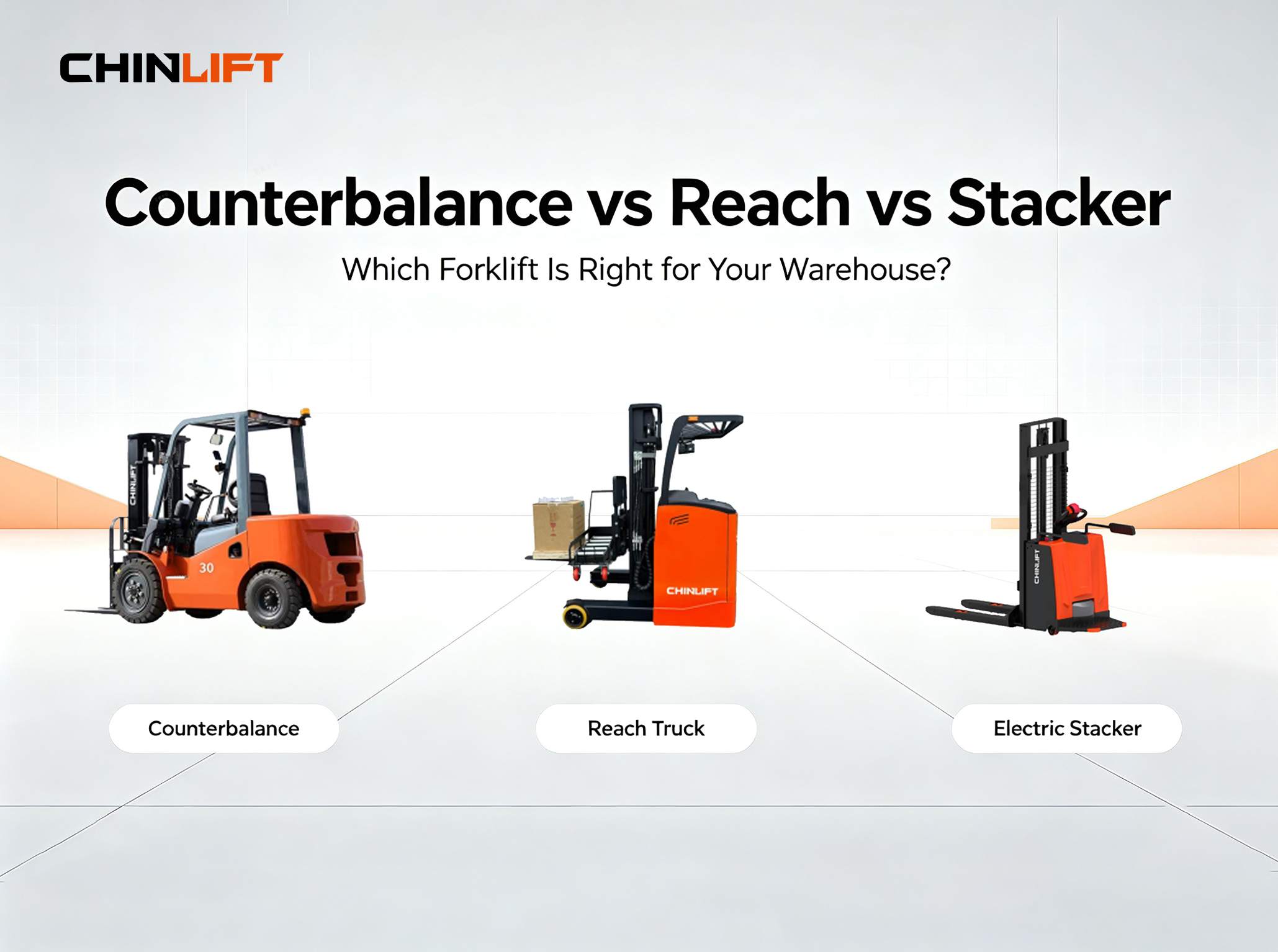
The three most common warehouse forklifts—counterbalanced, reach, and warehouse trucks—may all handle stacking, but their design logic is completely different. Pick the wrong one, and you'll either waste space or find it simply won't work.
Counterbalanced Forklift: The Versatile Workhorse
Counterweights at the rear balance the front load using leverage. Pros:stable, heavy-duty capable, 0.5–45 tons capacity (10+ tons typically diesel, outdoor use), fast travel speed, strong climbing ability. A typical 3 Ton Diesel Counterbalance Forklift is a popular choice for ports, construction sites, and heavy manufacturing, where outdoor operation and continuous heavy lifting are the norm.
Cons: large footprint, wide turning radius (needs 3.5–5.0m aisles), unsuitable for narrow layouts; load capacity drops as lift height increases—a 1.5-ton model may have under 1 ton of safe residual capacity at full height.
Best for: low-level racking (≤3–5m), spacious aisles, bulk goods transport—ports, construction sites, large manufacturing shops.
Reach Truck: The Narrow-Aisle Space Saver
The mast or forks extend forward to pick loads and retract during travel, shortening the truck's overall length. Pros: tight turning radius (minimum right-angle aisle as narrow as 2.8m), lifts up to 5–9m or higher with minimal load de-rating—a 1.5-ton reach truck can place the same load at 8m height. For operations requiring high-level order picking, a Stand on Reach Truck allows the operator to ride with the load, significantly improving productivity and reducing walk time across large warehouse floors.
Cons: typically under 2 tons capacity (lighter goods); sensitive to floor flatness; complex structure means higher maintenance costs.
Best for: high-density storage, high-bay racks, e-commerce order picking—especially when racks exceed 5m and aisles are narrow.
Warehouse Trucks (Pallet Trucks / Stackers): Flat-Floor & Low-Level Specialists
Light, compact, all-electric. Electric pallet trucks are basically "electric upgrades" of manual pallet jacks—electric drive and lift, ideal for 50–200m loop transport; cheaper than full-size electrics. Electric Stackers lift 1.6–5.5m with a minimum aisle of just 2.15m—perfect for line-side storage and production replenishment.
Cons: no high-bay or heavy long-haul capability—a single-purpose tool.
Best for: pallet trucks = horizontal transport, elevator/container loading, light short hauls; stackers = low-level shelving and just-in-time line feeding.
Bottom Line
- Counterbalanced = versatile but space-hungry → outdoor heavy loads, wide warehouses
- Reach = space-saving specialist → narrow aisles, high-bay storage
- Warehouse trucks = cost-effective helpers → flat-floor movement, light stacking
Match the truck to your actual working conditions—don't buy a machine that becomes a warehouse "showpiece." For a balanced mix of performance, reliability, and dealer support, exploring a reputable brand like CHINLIFT across these categories can give you a one-stop perspective on quality and after-sales service—because the right choice today keeps your warehouse running smoothly for years to come.
Frequently Asked Questions About three core models
Q1: My warehouse aisle is exactly 2.8 meters wide – do I have to choose a reach truck?
Not necessarily. 2.8m is the minimum for reach trucks, but some compact counterbalance models can also handle it. Key factor: rack height. Under 5m with heavy loads (>2 tons) → consider a short-wheelbase 3-ton counterbalance. Over 6m with high storage needs → reach truck is better. Do an "aisle width vs. turning radius" simulation before deciding.
Q2: Does a counterweight make counterbalanced forklifts safer?
Quite the opposite. The counterweight balances the front load—it doesn't make the truck safer. Counterbalanced forklifts have a high center of gravity and long tail, making them prone to tip-over on sharp turns or uneven ground. Reach trucks keep the load center between front and rear wheels during travel, offering better stability. Safety comes from three golden rules: never overload, never turn sharply, always travel with load at low height.
Q3: Can warehouse trucks fully replace reach trucks?
No. Stackers lift 1.6–5.5m but can't match reach trucks for high-bay retrieval. Stackers = line-side storage and low-level racking; reach trucks = high-density, high-bay warehouses. They complement each other, not replace.




 Network Supported